Blu-ray Review: Paul (2011)

With its frequent, flagrant references to mainly 1980s science fiction classics, and its irreverently comedic tone, Paul has all the hallmarks of a parody, yet it manages to feel anything but. Rather, it feels like a really enjoyable alien-flavoured road trip written by and starring two guys with evident love of the genre. Parodies rely on the viewer’s knowledge of a film’s antecedents to get the jokes, but whereas Paul has its fair share of in-jokes (some of which prove to be hilarious given the context in which they are used), it doesn’t rely on them. It’s successful on its own terms: as a comedy, as an action film, and also as a slightly twisted variation on the buddy movie.

Paul is the first film to feature the starring British combo of Simon Pegg and Nick Frost on which they haven’t collaborated with Edgar Wright. While he went off to make Scott Pilgrim Vs. The World, the two actors who bonded through their Star Wars obsession went on a road trip through the UFO hotspots of America. The film they wrote as a result recreates many of the experiences they had on the trip, with one major addition: foul-mouthed, pot-bellied, bulbous-headed E.T. Paul. As the title character and also, no doubt, the recipient of much of the budget (as a fully CGI creation), he’s a crucial component, one that is fortunately successful. Seth Rogen may seem an odd choice to voice such a critter, but his vocal stylings are perfectly suited to the character. The joke that he’s less of an alien in the US than the two wide-eyed tourists he tags along with proves to have plenty of comic mileage.

It’s clear from the Making Of material on the disc that Pegg and Frost see the film as their baby, but the choice of director also pays off. Greg Mottola, the man behind the wonderful Adventureland, brings real pathos, an eye for character, and also a great contact list of acting talent. The supporting roles are stuffed to the brim with scene stealers, including Jason Bateman, Bill Hader and Kristen Wiig, not to mention numerous cameos. Hader and Wiig in particular are just hilarious, though unlike in Adventureland they do not constitute a double act here: Hader is a hapless fed and Wiig an unwilling passenger on Paul’s interstate journey.

Fortunately, too, Pegg and Frost are as likeable as ever; you never question that they've been friends for years, and in many respects seem to just be playing themselves. Paul comes across as a very personal passion project for the pair, and they prove that they can work as a double act without Edgar Wright's frenetic direction. In Mottola's hands Paul is a more laid-back affair than the whizz-bangery of Shaun of the Dead and Hot Fuzz, which works brilliantly for the story. Pegg and Frost were aiming for the vibe of a classic road movie that just happened to have an alien in it, and despite all the explosions, juvenile gags, geeky references and Spielberg riffs, they pulled it off.


Release Information
Country: UK / Region: Free / Version: Single disc / Discs: 1 / Distributor: Universal

Presentation
Right from the Universal logo, Paul's warm, earthy colour timing is in evidence. Overall it looks great, no seams evident with the visual effects despite the relatively low budget, and with entirely satisfying detail. The soundtrack, too, is everything you'd expect of a modern movie, the music particularly making great use of the 5.1 configuration.

Extras
An ample and engaging array of supplements includes a commentary, 40 minute Making Of, gag reel, numerous featurettes (many Blu-ray exclusive), and an extended 'unrated' cut.


Summary
A surprisingly heartfelt yet also hilarious road trip, mixing an iconic American backdrop with a British fish-out-of-water sensibility and more than a little love of Hollywood science fiction.

Blu-ray Review: 13 Assassins (2011)

The title that 13 Assassins unavoidably brings to mind is the monumental Seven Samurai - both are about the titular group of warriors facing a siege of a small village - but the numerical advantage of Assassins proves to be indicative of a significant shortcoming. Whereas legendary director Akira Kurosawa luxuriated in three-plus hours to introduce his band of seven, Takashi Miike (a Japanese director famous for rather more sordid work) allows us only two hours in the company of thirteen. The end result is that it remains rather hard to remember each character, and virtually impossible to discern any particular traits in all but a couple of the cast. Few, if any, of them receive any individual screen time or opportunities to differentiate themselves from the rest.

Even the (at times tortuously) slow first act of the film ignores much in the way of character development, Miike more intent on detailing political alliances and establishing the late Shogun-era backdrop of the mid-19th Century. This section is largely confined to rather similar looking, murkily lit interiors, and conversations throw around many unknown names. The director's almost complete avoidance of establishing shots in this section gives it a hemmed-in, set-bound feel, which is not initially promising. Flashes of the trademark Miike brutality are the only memorable moments, albeit perhaps not for the most desirable reasons.

Then, however, after about an hour, proceedings open up considerably. Done with establishing the various clan rivalries and political manoeuvring, 13 Assassins settles down into a rather straightforward small group of heroes versus overwhelming odds scenario. The film finally explodes into an extraordinary orgy of swordplay that Miike manages to sustain for 45 thrilling minutes. Some suspension of disbelief is required - there's a bovine stampede rendered with iffy CGI, and the enemies do tend to line up one-by-one rather than make use of their huge numbers - but the incredible kineticism of the action, not to mention its supreme choreography, is a sight to see. Despite this the violence remains surprisingly restrained, extreme bloodletting kept to a relative minimum.

It's only in this final showdown where characters do come to the fore, their actions defining them better than any earlier dialogue scenes. Particularly Koji Yakusho as the heroes' leader Shinzaemon emerges as a monolithic figure, oozing gravitas, and the chilling detachment of Goro Inakagi's bloodlust-fuelled villain Lord Naritsugu proves an able foil. A shame, then, that just before we finally get to know some of the protagonists, most of them die, preventing any real investment in their plight.


Release Information
Country: UK / Region: B / Version: N/A / Discs: 1 / Distributor: Artificial Eye

Presentation
The film proves to be a bit disappointing in the looks department, with drab colours throughout (even in sunlight) and fairly soft detail. I was tempted to reach for the TV's dreaded Vivid colour settings to inject a bit of life - never a good sign. A high bitrate keeps any artifacting in check, however, meaning the quite strong grain never becomes intrusive. Sound-wise it's more successful, the DTS-HD track delivering thundering horse charges and the exaggerated thwunk of sword on flesh with ease.

Extras
Twenty minutes' worth of deleted scenes - all in 1080p/24 and with 5.1 DTS-HD audio to boot - are offcuts from the film's longer Japanese version. Most consist simply of extended ins and outs of scenes and add little, but there are a couple of more major trims, one in particular I'm grateful was cut, its outlandish tone jarring with the rest of the film. Typically, it's this contentious scene that the director cites as his favourite in the accompanying 20-minute interview (subtitled).


Summary
A thrilling hour of samurai heroics preceeded by an at times slightly dull set-up, 13 Assassins rewards patience with but never manages to overcome its more indelible flaws.

Blu-ray Review: Sucker Punch (2011)

To his detractors, Zack Snyder's output typifies style over substance: he sure knows how to shoot a pretty movie, but depth seems to be beyond his remit. 300 and Watchmen are, first and foremost, overwhelmingly exact visual recreations of their graphic novel sources. Sucker Punch is Snyder's first original screenplay (he receives story and co-writing credit), so this time he does not have an earlier work to imitate, but it has done nothing to silence his critics; even, for some, representing the nadir of his filmography to date.

You can see why it's a divisive film. Originality isn't an area of concern - it's quite unlike anything else you could think of - but the story and direction are certainly an acquired taste. Opening with what is effectively a music video montage, the first of many in the film, setting up our protagonist's plight: she's a 20-year-old orphan girl incarcerated in a mental asylum, and is only ever known to us as Baby Doll. She mentally escapes her predicament by fleeing into her imagination, where the asylum becomes a burlesque club, Baby Doll and her fellow female inmates the dancers. There are even further flights of fancy when she dances for the customers, as she dreams/hallucinates missions in which they have to recover key items that will help in their ultimate escape.

As is to be expected from Snyder, it's all highly stylised, and his penchant for slow motion and speed 'ramping' is indulged time and again. What makes it seem a somewhat hollow exercise is that there is never any particular contextual justification for the attention-grabbing flourishes. In particular, the outlandish fantasy worlds that Baby Doll dreams up when she dances have no connection whatsoever to anything in her experience; they feel manifestly more like a check list of what Snyder thinks would be cool. (Giant minigun-wielding robot samurais? Check! Steam powered Nazi zombies? Check!) Add to that a cast of young actresses who are rarely anything more than scantily clad and you have what errs dangerously close to a misogynist geek-out.

And yet, it avoids falling into the precipice thanks to appreciable conviction from the cast - rarely is there such a female-centric action movie - and a sincere attempt to tell a unique story. It's engrossing to an extent simply to try to predict where the film is heading, and the final act intensifies the drama substantially, albeit robbed of a certain emotional heft. Compare this to Christopher Nolan's Inception and you find two vastly different results from similar starting point, that being the delving into the subconscious world of dreams. Interestingly, those two creative forces are teaming up to bring us Superman next. Can such opposing sensibilities mesh into something coherent? You can be sure of one thing: it will look nice.


Release Information
Country: UK / Region: Free / Version: Rental / Discs: 1 / Distributor: Warner Bros.

Presentation
Given Snyder's emphasis on visuals, the Blu-ray is slightly disappointing. It's technically sound - there's no apparent smoothening of grain, and the encode handles the ever-present darkness with ease - but there's little 'pop', with subdued colours (an aesthetic choice, granted) and surprisingly soft detail. Nevertheless, it seems faithful to the source. The soundtrack is ferocious, with a dynamic range that might be a little too much - the dreams are sonic barrages, while the quieter bits in between sometimes have dialogue that's just too quiet.

Extras
This review disc is the rental version, which lacks the main special features offered in the retail release, those being Maximum Movie Mode and an extended cut of the film. Here you only get four motion comics and a very brief (sub-3-minute) look at the soundtrack.


Summary
Sucker Punch is not a film to watch unprepared, but those who know what to expect (and like the sound of it) may be reasonably entertained. Anyone else probably need not apply.

Cinema Review: Tinker Tailor Soldier Spy (2011)

James Bond might be cinema’s most famous spy, packing the gizmos, the gadgets and the girls, but when it comes to high-level on-screen deception, he has nearly met his match with grizzled legend Gary Oldman playing MI6 man George Smiley in the film adaptation of John le Carré’s tense commie-baiting Cold War novel first published in 1973.

Alec Guinness brought Smiley to the BBC’s screens in the late 1970s, but ignore misconceptions of Oldman revisiting the boring and cuddly spy – he brings a cooler, crueller and altogether darker characterisation to the cinematic rendition. Directed by Let The Right One In’s Tomas Alfredson, it’s taut, twisty and updated for 2011’s cinema-goers. Set in the early 1970s, Tinker Tailor Soldier Spy finds recently retired MI6 agent Smiley trying to adjust to life outside the Secret Service. But when a disgraced agent reappears with information about a mole inside the Circus – the British intelligence service – Smiley cannot resist one last indulgence in the world of espionage. Tasked with investigating which of his former pals has turned against the organisation, Smiley focuses on four suspects. They are all experienced, successful agents, but their past histories, rivalries and friendships conspire to hamper his bid to unearth the mole.

The whole experience is unflinchingly authentic and is as low-tech as possible, the polar opposite of Bond where listening to conversations rather than bangs and booms will bring rewards. The film recalls the era in which it is set – when tense paranoia classics such as The Conversation and The Manchurian Candidate dominated Hollywood filmmaking – and it is packed with talent. Alongside elder Brit heavyweights such as Oldman, Colin Firth and Kathy Burke are spunky young bucks Tom Hardy, Stephen Graham and Benedict Cumberbatch.

The performances are all good to brilliant, especially Oldman, but the main problems arise with the screenplay. Peter Straughan and Bridget O’Connor fail to provide any social, historical or political context to give the mole hunt any great urgency or wider importance. Focussing on the overlong saga of the love affair between a British spy and the wife of a Moscow agent is fine but could have been trimmed down to give the main candidates a bigger chance to breathe. Alfredson infuses a sombre Scandinavian melancholy and the film is certainly stylish and evocative enough but it asks the audience too many questions without providing enough answers. At times one feels like begging for more evidence, more back story, more understanding and all we are left is Smiley randomly having a breakthrough justified with no real rhyme or reason. Ultimately, Alfredson nearly makes Tinker Tailor Soldier Spy emotionally vacuous – the revelation is nowhere near as astonishing as it should be and some members of the audience will end up simply not caring. In contrast, with a grown-up thriller some may argue the whole point is to become engrossed and draw your own opinions or, failing that, simply admit to yourself that slow-burners where concentration is key are not your genre of choice.


Summary
A standard thriller in which the journey and the disclosure could have been so much more. Tinker Tailor Soldier Spy is certainly entertaining but thinks of itself as being more intelligent than it actually is with miniscule nuances few will notice.

Blu-ray Review: Doctor Zhivago (1965)

In retrospect, 1965 was the year that represented the end of the old studio system, before the new blood of the late '60s ushered in a revolution in American cinema. It was in that year that two of Hollywood's biggest ever hits were released, both belonging to defiantly old-fashioned genres: the musical and the epic. The musical in question was The Sound of Music, against which the epic Doctor Zhivago was unlucky to be competing for awards and commercial success: it was one of the biggest commercial grossers of all time, but was topped by Julie Andrews classic (they still lie eighth and third respectively on the list of adjusted box office), which also romped home with the major Academy Awards. Hollywood tried to capitalise on the success of both films in subsequent years, but all those efforts were doomed to failure, proving almost financially ruinous in some cases. What's remarkable looking back now on Zhivago is how much popular taste has changed: it's a great film, certainly, but not an easy one to love, with pacing and moral grey areas from which modern blockbusters would recoil in horror.

Much was expected from David Lean in the wake of Lawrence of Arabia. It was to Boris Pasternak's novel he turned, banned in Russia for being anti-communist and therefore the beneficiary of much publicity and controversy in the years since its first publication in Italy, in 1958. The story provided both the scope and scale to match Lawrence, but also a romantic core that the purely male-centric desert epic wholly lacked. Zhivago is a love story set against the backdrop of the First World War and the Russian Revolution, spanning years, and proved far from easy to adapt (Lean's screenplay was again penned by Robert Bolt). The difficulties of the source novel are evident in the finished film, notably an erratic pace and a romance that barely appears for two hours of the running time, but it is these apparent flaws that in fact contribute to its compelling uniqueness.

Zhivago has been much likened to a Russian Gone With the Wind, which may be an easy comparison to make but remains valid. Structurally they echo one another, in terms of a slow beginning set prior to an outbreak of war, followed by the main characters being thrust into a conflict before returning home to a scene of devastation. (And that's all in the first half.) Similarly the romances are unconventional, never actually coming to fruition until near the end of each mammoth film. Zhivago bests its precursor, however, due to its director's vision and storytelling genius. Many of its most brilliant sequences could come from a silent movie, their power generated entirely through Lean's mastery of technique married to Maurice Jarre's haunting music. Witness the chilling suicide attempt scene, or the famous onset of spring montage in which snow dissolves into a carpet of daffodils. Evident throughout is Lean's meticulous planning; there's barely a cut that isn't perfectly motivated, or a transition not imbued with meaning.

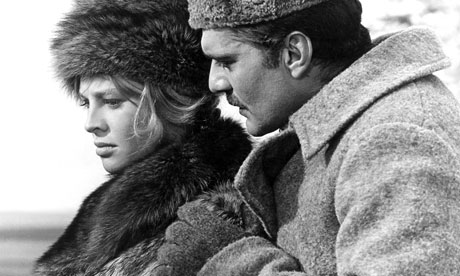
With such emphasis on the visuals and scale in a Lean film, the actors could get lost in the scenery, but Zhivago boasts some indelible performances that ensure that doesn't happen. The casting of the Egyptian Omar Sharif was an offbeat choice for the title character, but the actor's commitment and sheer likeability render any concerns about his manifestly non-Slavic origins moot. Julie Christie's Lara, meanwhile, is one of cinema's greatest ever beauties, Lean's camera often lingering on her captivating eyes and golden hair (one of the film's concessions to '60s styling - who knew hairspray existed in revolutionary Russia?). The magnetic Rod Steiger secured an Oscar as the sort-of-villain Komarovsky, but Tom Courtenay is just as good as Lara's brother Pasha, who experiences one of the most dramatic, moving arcs.

Again and again, though, the crux of the film comes back to the core romance, but those expecting a traditional love story will likely be disappointed. Not only do obstacles constantly intrude, preventing their first kiss until well after the intermission, it's an adulterous relationship even once they do admit their feelings. Zhivago is married to Tonya (Geraldine Chaplin), who is portrayed as more or less a saint, so one can't help but feel sad for her despite the chemistry and fireworks of her husband's illicit affair. It's actually elements like these that elevate the film to greater heights: it would have been much easier and more dramatically straightforward to make Zhivago single or even a widower in the purpose of eliminating a difficult moral quandary for the audience.

In fact, it was audiences who saw the greatness of the film first, critics having been unfairly savage. This was in an age when critics actually had influence over a film's success, so the fact that Zhivago was able to weather such scorn is a testament to its hypnotic power. Lean himself threatened to never make a film again after the critics' barbs, but it would in fact be the even more hostile reception of his next film, 1970's Ryan's Daughter (again unjust, but that's another story), that sent him into self-imposed exile.


Release Information
Country: UK / Region: Free / Version: 45th Anniversary / Discs: 1 BD, 1 DVD / Distributor: Warner Bros.

Presentation
For its 45th anniversary, Doctor Zhivago has received the full restoration treatment, but the image and sound quality remains occasionally hamstrung by the source. It's a shame that Lean was not allowed to shoot in 70mm, as he had wished, as it's ironically the quest for the best possible print quality that has caused the original negative to become so worn through overuse (Lean didn't want dupe prints to be used). Nevertheless the restorers have worked some digital magic here, eliminating any sign of print damage or even specks of dust. Detail in many scenes is exemplary. The visuals are mainly hampered by the presence of very noticeable halos around hard edges, such as people walking in snow. Some investigation has revealed that these anomalies seem to be inherent in the print, rather than a result of newly applied edge enhancement, but they remain distracting at times.

The sound, although present in DTS-HD 5.1, sounds thin at times, with limited use of surround channels (the first scene at the train station, when Tonya arrives, sounds particularly tinny). It's a faithful rendering of the source, however, and the wonderful score in particular sounds lush and full-bodied.

Extras
A two-part 40-minute featurette is the only new extra created for this release, but it's a good one, featuring the involvement of many fans of the film from today's Hollywood set. There's surprisingly in-depth textual analysis of certain scenes which offers excellent insight, pointing out things that are easy to miss when you're wrapped up in the story. The commentary, featuring Sandra Lean, Omar Sharif and Rod Steiger was recorded for the earlier DVD but it's still a worthwhile listen, though the 200 minute runtime does make for some gaps, which is reasonable enough. The rest is on Disc 2, which duplicates the second disc of the previous DVD set, the highlight of which being the very good hour-long "Doctor Zhivago: The Making of a Russian Epic" from 1995, which is put together with a little more care and detail than many modern documentaries, which are a dime a dozen. It's only a shame that Julie Christie doesn't contribute. Other than that, there are a handful of vintage featurettes and interviews.

It's nice to have the film contained on a single disc, and not a flipper like the previous DVD, but it's a shame that Warner Bros have left almost 10GB free on the Blu-ray - why not increase the bitrate of the feature, or at least put the rest of the features on the first disc?


Summary
A magnificent recreation of a time embroiled in political upheaval, Doctor Zhivago may not be as acclaimed as Lawrence of Arabia, but David Lean's mastery of his art is still plain to see, producing a typically brilliant combination of scale and substance.

News: Ridley's Blade Running again

Apparently Prometheus has given him a taste for revisiting past successes. Yes, Sir Ridley of Scott has, according to Deadline New York, signed up to "direct and produce" a new film that is in some way related to his 1982 classic, Blade Runner (see FilmVerdict Blu-ray Review). Just like Prometheus is in some way related to Alien - in that case, all the signs point towards a prequel.

Whether Blade Runner's new cinematic offspring will take the form of a prequel, sequel, side-quel or whatever remains completely up in the air. I'd be most interested if Harrison Ford came back to reprise his role from the first film. How cool would it be to see an old, washed up Deckard try to reclaim some past glory? Unfortunately that's unlikely for many reasons. The main one is that Ford has made no secret of loathing the whole filming experience first time round. However, Ford is not the box office draw he once was, Cowboys & Aliens having recently slightly flopped, and he has, of course, proven willing to reprise an old character in the case of Indiana Jones.

The fact is that Blade Runner's world is endlessly fascinating and looks great, so the material is ripe for new exploration. However, I'd be completely against this if it was from anyone other than Scott himself. A small pipe dream that surely won't come to fruition is that he uses the same effects technology as the last one - say no to CGI. And hey, Doug Trumbull has just worked on The Tree of Life, so he's still on his game, right?

So, revisiting Alien, Blade Runner... next, it'll be the long awaited Gladiator sequel.*

*Warning: completely baseless conjecture.

Blu-ray Review: Rango (2011)

Rango is what Gore Verbinski made while not directing the fourth Pirates of the Caribbean. Freed from the shackles of a mega-franchise, and the pressure to meet a too-tight release date, Rango is a quirky, offbeat animation with the director's stamp all over it. After seeing the Rob Marshall-directed latest Pirates, efficient if anodyne, it's evident that the source of much of the surreality and kookiness that defined the earlier entries in the series was Verbinski himself. Certainly, those qualities manifested themselves in perhaps less successful fashion in At World's End, but the real problem there was lack of a script. In Rango, not only is he able to let his idiosyncratic imagination run wild, it's married to a good story penned with the assistance of seasoned scribe John Logan.

The eponymous Rango is the hero of the tale, a pet chameleon, who, through a vehicular mishap, finds himself stranded in the middle of the desert. Soon he stumbles upon the ramshackle settlement of Dirt, where numerous desert-dwelling animals have formed a town straight out of the wild west. Rango, a wannabe thespian, styles himself as a travelling gunslinger and accidentally manages to become the town hero. It emerges that Dirt has a severe water shortage which may have suspicious origins, so it's up to Rango to solve it. Surprisingly, for a family film, that involves numerous similarities to the plot of Chinatown, while simultaneously allowing Verbinksi to indulge his obvious passion for the Western genre with numerous references to the likes of Once Upon a Time in the West and High Noon. Hans Zimmer is able to build on his Morricone riff in the third Pirates with a full score indebted to the maestro.

The real treat with Rango is the design of the film. Not only is it unique - the motley band of critters are all full of character but none are exactly cute - it is also beautifully crafted. The textures and dirt-encrusted tangibility of the visuals set it apart from any other computer animation. Moreover, the film's eccentric, sometimes mischievous, sense of humour is extremely endearing, with jokes more aimed at adults than young 'uns. There are sights and sounds here that straddle the border between genius and madness - witness the attack on a carriage by bat-riding prairie dogs scored to Ride of the Valkyries, for example. Such wanton oddness is refreshing in a big-budget film, and it is entirely down to this individuality that Rango manages to be such a wacky delight.


Release Information
Country: UK / Region: B (unconfirmed) / Version: Triple Play / Discs: 1 BD, 1 DVD / Distributor: Paramount

Presentation
As expected, Rango looks flawless. The detail in the animation - by CGI wizards ILM, this being the first time they've produced an all-animated movie - is incredible, and is shown off brilliantly in this stunning presentation. The DTS-HD soundtrack is similarly faultless, bringing to life Verbinski's world in all its peculiarities.

Extras
There are two versions of the film to watch, the extended cut being about five minutes longer, its main difference being an extended ending (not necessarily an improvement, but it is amusing). A commentary accompanies the extended cut, while the theatrical can be watched with Picture-in-Picture storyboards. Elsewhere there's a healthy two-part, fifty-minute Making Of, and an enjoyable twenty-minute piece looking at the real creatures that the characters were based on, presented by a guy who seems to be the South African Steve Irwin. The deleted scenes are simply a compilation of those added to extended cut.


Summary
Rango may not get off to the most promising start, but when the titular character reaches Dirt, the film explodes into eccentric life with a character all its own.

Cinema Review: Captain America - The First Avenger (2011)

As the last of Marvel's A-list names to reach the big screen in the current batch of comic book adaptations, the challenge faced by Captain America is more than simply living up to what's gone before. It presents the unique difficulty of its innate jingoism. Who could take seriously a hero calling himself Captain America, except proud Americans? The way the filmmakers of Captain America: The First Avenger (to give it its whole, clunky, sequel-teasing title) tackle this thorny issue is inspired. They embrace the inherent cheesiness of the concept while simultaneously managing to suppress its ridiculousness. In this incarnation, Captain America is a promotional tool concocted by the US military to raise money for the war effort against Hitler. The goofy costume, faithful to the last thread, even makes an appearance, but no-one is expecting a straight face here. That's not to say, though, that the film is a comedy. It in fact plays everything with real sincerity, sidestepping the potential pitfalls with ingenuity and style.

Of course, this Captain America does not last the whole film without upgrading his duds: the one shown in the promotional photography is the more practical, and frankly cool, version that appears once he starts kicking Nazi butt, against the orders of his superiors. Such an upstanding, morally sound character could have been dull, but in the hands of Chris Evans - the best thing about the Fantastic Four movies, another Marvel property - he's likeable and interesting. He's given a great arc, with an origin story that feels worth the time spent on it; in fact this is one of those occasions where the origin half of the tale make be the best. Evans' Steve Rogers starts out hilariously scrawny, thanks to the wonders of CG trickery, before beefing up in the super-soldier experiment that turns him into the one-man army of the title. The early scenes for once seem worthwhile rather than perfunctory, demonstrating great wit and sense of period.

Indeed, the period setting is one of the reasons Captain America feels so fresh. The World War II era may be well mined on screen but not in this genre, resulting in a mix of the familiar (evil Nazis!) with the new (evil Nazis versus a superhero in World War II!). In fact, Cap's super-humanness is toned down to simply heightened levels of strength, speed and agility, making him more relatable than, say, the impervious Superman. The film's Indiana Jones overtones cannot be a coincidence, director Joe Johnston having worked alongside Spielberg, his career starting at ILM before directing the likes of The Rocketeer (a test run for this film, it now seems) and Jurassic Park III. Hugo Weaving's villain, the diabolical Red Skull, is a match for Raiders' menagerie of menaces, chewing the scenery with glee.

Where it falls short of Indy's genre-defining heights is in its pacing - sometimes sluggish where it should be sprightly - and reluctance to go all-out in the action scenes, none of which offer anything new. But still the film's emphasis on character is commendable, its steady action-adventure construction endearingly old fashioned. Alan Silvestri's score is also a throwback, with not an electronic note to be found and with a pleasing propensity for the traditional fanfare and recognisable themes. These elements cohere in what may be Marvel's best internally produced effort yet - yes, better than Iron Man - and certainly its best lead-in to The Avengers. Unfortunately, the need to set up next year's big conflagration cheapens the finale of this film somewhat, but it still does manage to stand alone as a satisfying adventure within its own right, to an extent that its stablemates have not managed.


Summary
An enjoyable wartime adventure cast from the same mould as Indiana Jones, Captain America may not be quite the effortless heroic yarn it aspires to be, but its sheer entertainment value is hard to knock.

Cinema Review: Super 8 (2011)

Super 8 sets its stall out early with its opening logos. After the familiar Paramount peak, we see a boy cycling in front of the moon: the Amblin logo, Steven Spielberg's company, its iconic motif of course spawned from E.T.. Only then is it followed by J.J. Abrams' Bad Robot insignia. Not only does it show just how reverently Abrams regards Spielberg, it also encapsulates the tone, subject matter and even time period of the film to follow. Super 8 is a shameless Spielberg riff through and through - and manages to be the best Spielberg film since the heyday of The Beard himself. A cinematic love child of Close Encounters and E.T., albeit with a rather less friendly alien beastie at its centre, Super 8 encapsulates exactly the sort of exuberant fun, married to real heart and soul, that propelled the young Spielberg to such unmatched heights of critical and commercial success.

Like E.T., and also fellow 80s classic Stand By Me, Super 8 is a story of childhood, in which precocious young actors are the stars, but, also like them, it is not a 'kids save the world' movie. Rather, it is about a group of friends thrust into an unfamiliar situation, and who deal with it as best they can. Such a movie relies hugely upon its young performers; fortunately, in Super 8 they shine. Their naturalism and ease in front of the camera is a testament to their individual talent, a brilliant casting job, and superb direction from Abrams. A mark of many of the best directors is how well they coax convincing performances from children; in that respect Abrams excels. What's more, each of these kids feels human and fully developed - sure, they do slot into broad types (the chubby one, the geek, etc.) but they feel like friends you could have had in high school. Their behaviour and interplay comes across as entirely authentic, spontaneous and often hilarious. It's a mark of the sheer entertainment value of these scenes that the science fiction stuff almost feels like a sideshow.

That's not to say that Abrams drops the ball when it comes to the thrills. Not a bit of it. Super 8 is as tight and intense an experience as you could hope for, propelled by pitch perfect pacing and numerous moments of great suspense. The plot kicks off when our central band of boys (and girl), filming their own zombie movie, happen to get front row seats to a mammoth train crash. Naturally, it's not just any train crash - it's a US Air Force train, whose contents are a closely guarded, and now missing, secret. Cue the military invading the small town of Lillian, and some déjà vu for fans of Close Encounters. The crash itself is an absurdly extended cacophony of chaos, which sets the wheels of the plot into inexorable, gripping motion. The way Abrams drip-feeds the mysteries is reminiscent of Lost - the TV show he co-created - but this time, you don't have to wait six years for an answer that may not even be given. Here, the script is honed and polished enough that every element has a payoff and a reason for existing, making the resolution all the more satisfying.

The heart of the film lies with Joe (Joel Courtney) and Alice (Elle Fanning). At the beginning of the film, Joe has just lost his mother; his subsequent difficulties with his lone parent father (Kyle Chandler, receiving deserved exposure) form an emotional backbone to his arc. Alice is the outsider of the group, invited into the boys' inner circle by their need to have a leading lady in their homemade film. She's slightly older and wiser than them, so the casting of the experienced Fanning is ideal. Her story too is tremendously moving, reaching a tearful, beautifully performed moment late on that may tug on the most sceptical heartstrings. Abrams proves an assured hand at balancing such emotional peaks with visceral action, his prowess in the latter already having been shown in his two previous features (Star Trek and Mission: Impossible III). Super 8 feels his most fully cinematic venture yet, the director relaxing his propensity for shaky, tight close-ups and having the confidence to pull back to wider shots with fewer cuts when called for.

If there's a misstep, it's in the alien itself: a malformed jumble of undiscernable body parts, once finally revealed. Its closest cousin is the Cloverfield monster (another Abrams producing gig). Basically, it's neither memorable or clear in its design, the director having apparently prioritised anatomical originality over anything relatable. Thankfully, the creature is not lingered on much, never even quite receiving a clear wide shot, so it doesn't prove to be damaging, and it's more of a plot catalyst than an integral component. This is a film driven by a childlike sense of wonder and lack of cynicism - traits all too rare in both films and reality these days - and demonstrates the inspiring potential of the blockbuster, reaching back to the days when it was not a dirty word.


Summary
Driven by nostalgia but not dependent on it, Super 8 is the best film of the summer, the best film of the year so far, and one of the best blockbusters in many a moon.

Cinema Review: The Tree of Life (2011)

Life, the universe and everything. That's the unambitious subject matter of Terrence Malick's fifth feature. Never one to think small, Malick has here made a bewildering yet beautiful dreamlike fusion of music and images. Apparently taking his cue from 2001: A Space Odyssey, the film spans from prehistory to modern times, yet this film is diametrically opposed to Kubrick's rigidly structured approach. The Tree of Life is a free-flowing, meandering, practically formless film, resembling the fractured non-linearity of memory, which is surely intentional. The result is even less mainstream and conventional than the director's previous films, none of which could be described by either of those terms. This is a pure expression of Malickness.

Say goodbye to dialogue, A-to-B storytelling, even an apparent aim. The beginning of the film is particularly mystifying, jumping between three disparate settings and times: leafy 1950s American suburbia, the glass-and-concrete modern city, and the birth of the universe. The beauty on display is inarguable, be it the lush woodland or the rupturing crust of the early Earth, but it lacks any sort of handle to give an audience member something to hang on to. It comes across like an art installation: striking, intriguing, but also a bit distancing, and yes, even pretentious. Malick overdoes some of his stylistic tics, such as the rambling inner monologues, and the gradual "tilt up to treetops" shot (seriously, there's a drinking game in there somewhere). The prehistoric scenes are spectacles to behold, but you're left to ponder the point of, say, the dinosaur flopping on the beach, any explanations unforthcoming from the film itself.

Eventually, some sort of focus does emerge. This is fundamentally the story of the childhood years of three brothers in 1950s America, who live in fear of their domineering father (Brad Pitt, as unlikeable as he's ever likely to be, while still remaining human). That's it as far as plot goes. We follow the characters through the short chapter of their lives, watching them interact, misbehave, and learn life lessons. It's hard not to see it as autobiographical in some way. However, Malick's unwillingness to concede to anything approaching convention at times seems wilfully obtuse; you yearn at times for a simple conversation between characters. Malick's mastery of the camera is still in evidence; his visuals tell a story with more potency than words could.

Of the three time periods, it's the modern day one that never finds an identity. Sean Penn wanders around streets and buildings looking a bit lost before he stumbles on some strange windswept beach. To detail further would spoil the ending of the film, but suffice to say, its religious and spiritual overtones, not to mention overall weirdness, may be too much for even those people who have made it that far.


Summary
Esoteric and maddening, The Tree of Life is certainly unique. To some, it will be like watching paint dry; to others, a thing of transcendent beauty. Its vision - and the suspicion that it will benefit from repeat viewings - earns it three stars, but its ambition is not quite matched by its distancing, mannered execution.

 
Design by Free WordPress Themes | Bloggerized by Lasantha - Premium Blogger Themes | Customised by FilmVerdict